What to Look for in a Cat Hotel in Singapore: 7 Things Every Cat Owner Should Check
Not all cat hotels in Singapore are equal. Before you book, check these 7 things: cat-only policy, AVS licence, private suites, Fear Free care, live webcams.
By Charlotte · Founder••5 min read
Seven things decide whether your cat comes home the same cat: a cat-only policy with no exceptions, a current AVS licence, private suites rather than shared ones, Fear Free trained handling, a webcam you control yourself, a documented daily routine, and a team small enough to know your cat by name. Google rating and distance, which is what most first-time owners book on, capture none of them. A year into running Kuro I'd already lost count of the owners who rang the buzzer with a cat who'd just been at a "vet-and-boarding" next to a barking run of dachshunds and needed a reset. Check these before you book any of them, ours included.
1. Is it a cat-only facility?
People underestimate this. Cats and dogs communicate through scent and sound, so even if the animals are housed in separate rooms, the presence of dogs is a real stressor for cats. A genuine cat-only policy means no exceptions whatsoever.
2. Does the facility hold a valid AVS licence?
Singapore requires animal boarding businesses to obtain an AVS licence from the Animal and Veterinary Service under the National Parks Board. That licensing process covers hygiene, space standards, and animal welfare protocols. Reputable establishments display their licence number prominently; if you can't see it on the website or on the wall, ask.
3. Are the suites private or shared?
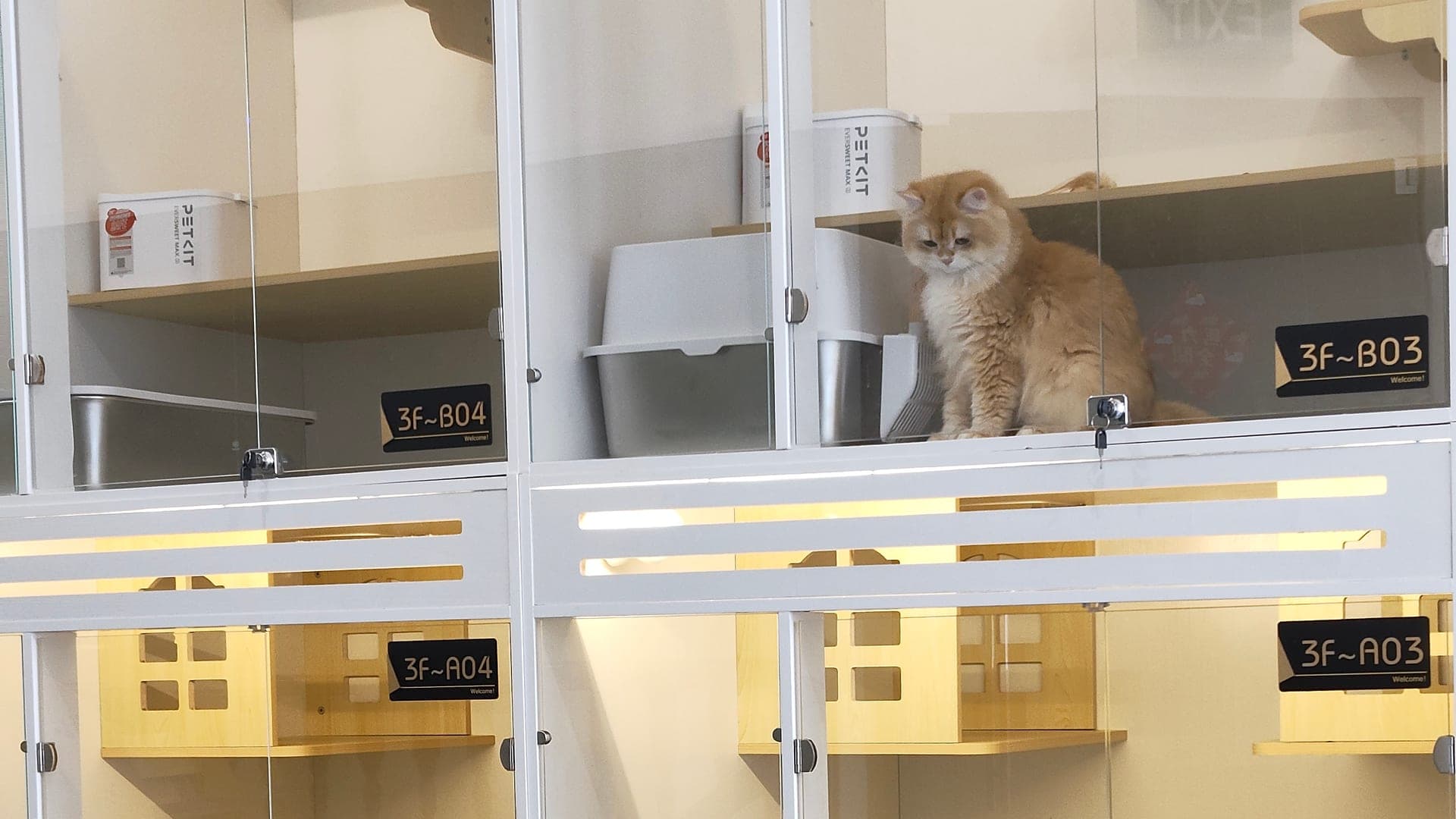
Choose a private suite over a shared one. In shared environments your cat is in close proximity to unfamiliar cats, which can cause stress, territorial anxiety, and in some cases, the transmission of illness. Private suites give each guest a dedicated feeding station, individual litter facilities, and a personal retreat space.
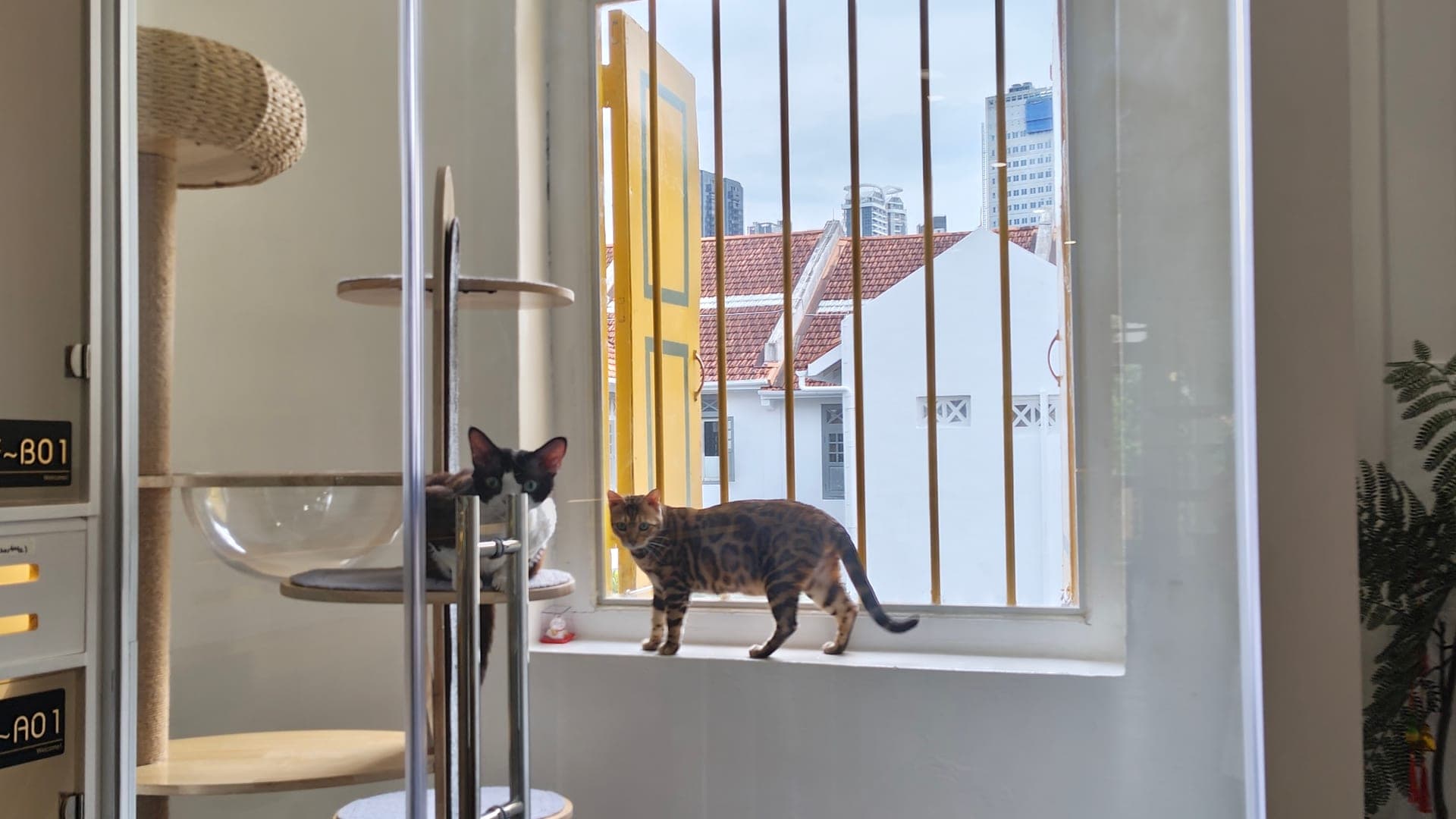
What private should mean: your cat's own litter, bowls, climbing tree, and a heritage window with the city beyond it. Two cats only ever share a suite when they arrived from the same home.
4. Is the team Fear Free certified?
Fear Free certification indicates staff training in low-stress handling techniques, anxiety-reducing environmental design, and feline behaviour recognition. Cats are extremely sensitive to handling. A well-meaning but untrained handler can cause a cat to associate boarding with fear, making every subsequent stay harder. (More on what Fear Free actually means in practice.)
5. Can you watch your cat in real time?
24/7 live webcam access is now a standard offering at quality cat hotels. Owner-controlled access, where you retrieve footage directly via smartphone anytime, is more transparent than staff-mediated footage reviews. At Kuro every suite has a camera you log into yourself, from anywhere and at any hour, and you can talk to your cat through it rather than asking someone to go and look.
6. What does the daily care routine look like?
Inquire about:
Suite cleaning frequency
Pet-safe cleaning product usage
Feeding schedule alignment with home routines
Individual enrichment time per cat
Illness response protocols
7. Will your cat be known as an individual?
At smaller facilities, staff recognise each cat by name, temperament, and preference. The staff know that your cat is shy around strangers, that they prefer their food served at room temperature, that they sleep better with a worn piece of your clothing in the suite. That kind of personalisation requires deliberate capacity limits and thorough intake procedures; it's the reason we cap occupancy and keep a detailed care plan for every guest.
The audit that matters in the end: a guest relaxed enough to roll.
What should you check before booking a cat hotel?
Cat-only policy with no exceptions
Current valid AVS licence (verify the number)
Private suites exclusively
Fear Free staff certification
Owner-controlled 24/7 webcam access
Documented daily care protocols
Individualised care planning
Work through that list and you have most of what matters at the door. If you are earlier than that and still weighing whether to board at all, our complete guide to cat boarding in Singapore covers the costs, the licensing, and the questions this checklist takes for granted.
Frequently Asked Questions
1Is it a cat-only facility?▼
A genuine cat-only policy matters because cats communicate through scent and sound; even dogs housed in separate rooms are a significant stressor. Ask whether the facility accepts any exceptions and how the space is segregated.
2Does the facility hold a valid AVS licence?▼
Singapore requires animal boarding businesses to be licensed by the Animal and Veterinary Service (AVS) under the National Parks Board. Licensed premises have passed inspections covering hygiene, space standards, and welfare protocols, and reputable operators display their licence number openly.
3Are the suites private or shared?▼
Private suites separate cats from unfamiliar animals and give each guest dedicated feeding, litter and rest space. Ask whether cats from different households ever share a room.
4Is the team Fear Free certified?▼
Fear Free certification indicates staff training in low-stress handling, anxiety-reducing environmental design, and feline behaviour recognition. Cats are extremely sensitive to handling, so an untrained handler can cause lasting fear associations with boarding.
5Can you watch your cat in real time?▼
24/7 live webcam access is a standard offering at quality cat hotels. Owner-controlled access (retrieving footage directly from your phone at any time) is more transparent than relying on staff-mediated footage reviews.
6What does the daily care routine look like?▼
Ask how often suites are cleaned, whether the cleaning products used are pet-safe, whether feeding follows your cat's home schedule, how much one-on-one time each cat gets, and what the facility's illness response protocol is. Good operators document these rather than improvise.
7Will your cat be known as an individual?▼
At smaller facilities, staff recognise each cat by name, temperament, and preference, from food temperature to bedding choices. This personalisation comes from deliberate capacity limits and thorough intake procedures rather than friendliness alone.