How to introduce a second cat at home in Singapore: a separate room, scent swapping, gradual contact, duplicate resources, and the signs that mean slow down.
By Charlotte · Founder••6 min read
A resident cat treats the home as a territory it has already mapped by scent, and a new arrival walks straight into that map. The introductions that go well are almost always the slow ones: two cats who meet through a door, then a gap, then a room, and only later share a sofa. Here is how to pace that in an ordinary Singapore flat, and what to watch for along the way.
Start with a vet check and a separate room
Before any introduction, have the new cat seen by your vet. A new cat can carry parasites or an infection your resident cat has not met, and it is far easier to sort that out with a closed door between them. Ask your vet about vaccinations, testing, and anything to watch for in the first weeks. This post is general guidance, not veterinary advice.
Then give the newcomer a room of its own. A spare bedroom, a study or even a bathroom will do, as long as the door shuts firmly and the room holds everything a cat needs: food, water, a litter tray, somewhere to hide and somewhere to climb. This is the new cat's base. It lets them settle without being chased, and it lets your resident cat notice that something has changed without having to face it.
Plan for this room to stay in use for several days at least, and often longer. No timetable suits every pair. Nervous cats and cats with strong territories tend to need more time.
Swap scent before you swap sight
Cats learn each other by smell first. While they are still on opposite sides of a door, rub a soft cloth on one cat's cheeks and leave it near the other cat's food or bed. Swap bedding between the two, and let each cat explore the other's room while you keep the other one out of it.
Watch how each cat reacts. A sniff and a shrug is a good sign. Hissing at the cloth, or refusing to go near it, tells you the gap between them needs to stay wider a little longer. Feeding each cat on either side of the closed door is another gentle step, because the smell of the other cat starts to sit beside something pleasant.
Let them see each other, briefly
When both cats are eating and behaving normally around the scent swaps, move to sight. A baby gate, a door held open a few centimetres, or a screen across the doorway all work. Keep the first sessions short and the mood calm, and end them while both cats are still relaxed rather than waiting for one of them to react.
Offer a treat or a meal at a comfortable distance on each side, and close the distance only as long as they stay easy. A wand toy played near the gap can help too, since it gives both cats something to look at other than each other.
Duplicate the resources
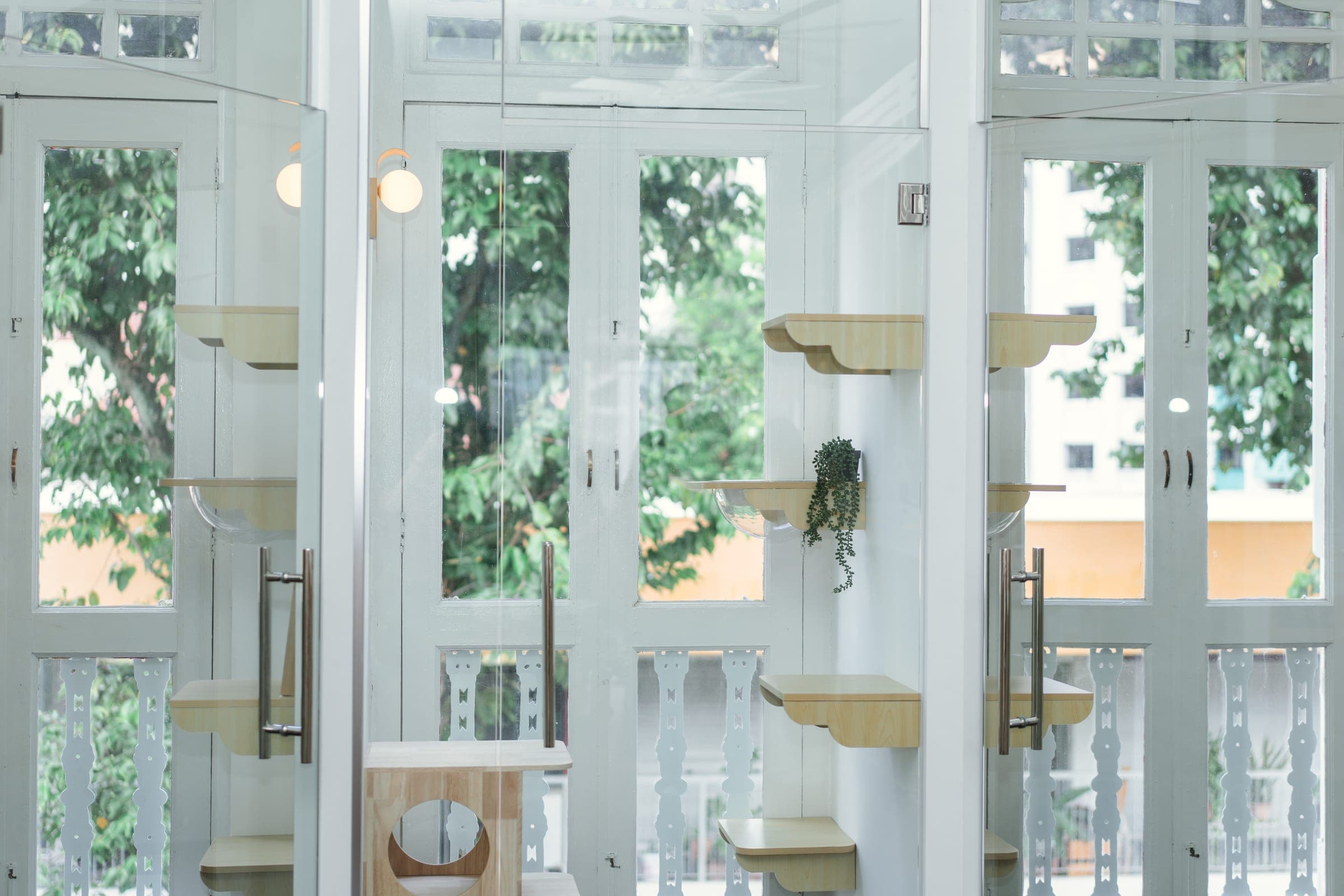
Cats guard what they value. In a home with two cats, the usual advice is one more litter tray than the number of cats, separate food and water stations, and at least two of every good perch or hiding spot, placed so neither cat can block the other in. Vertical space matters in small flats: a shelf or a cat tree lets the more anxious cat watch the room without being in the middle of it.
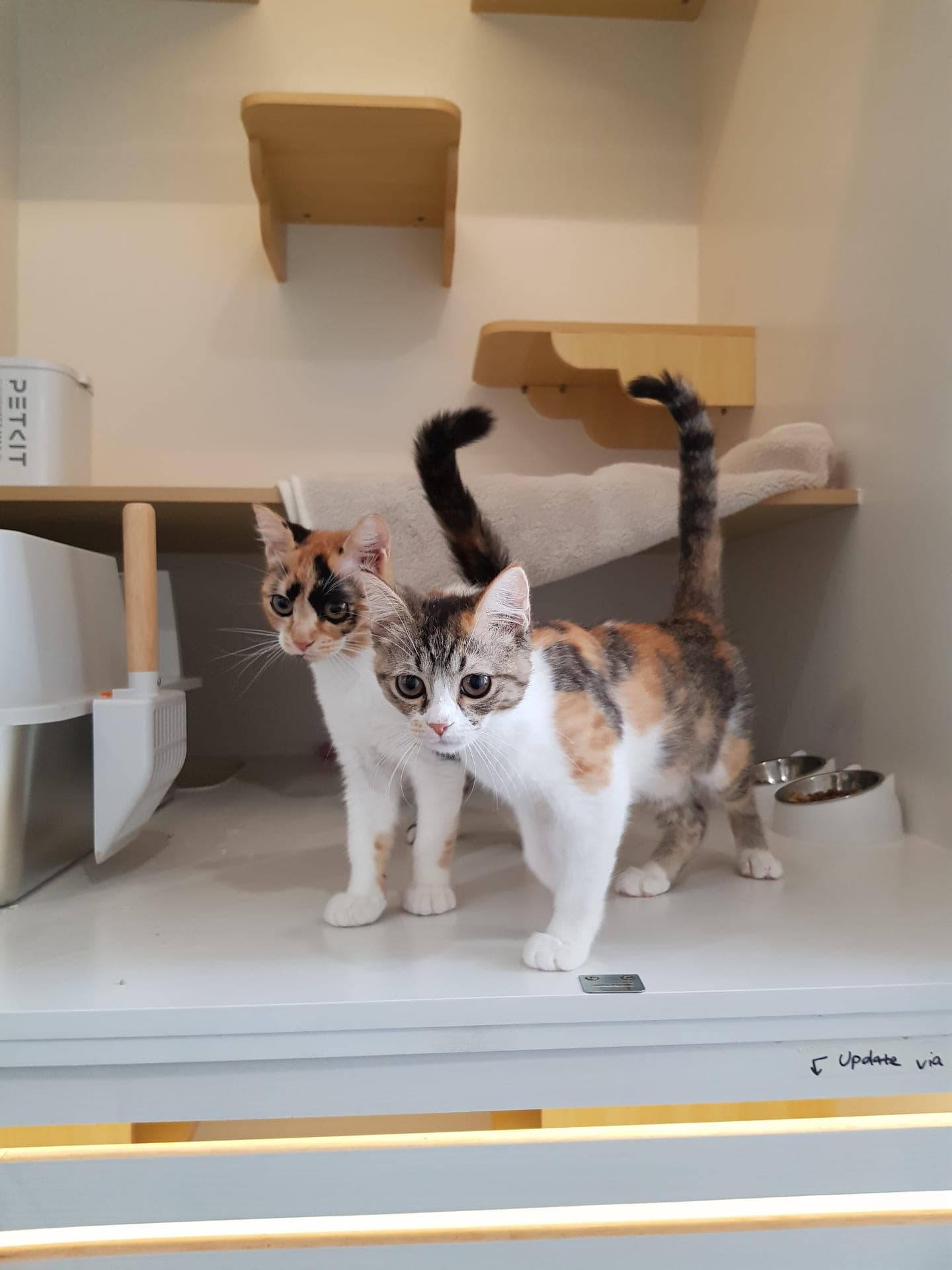
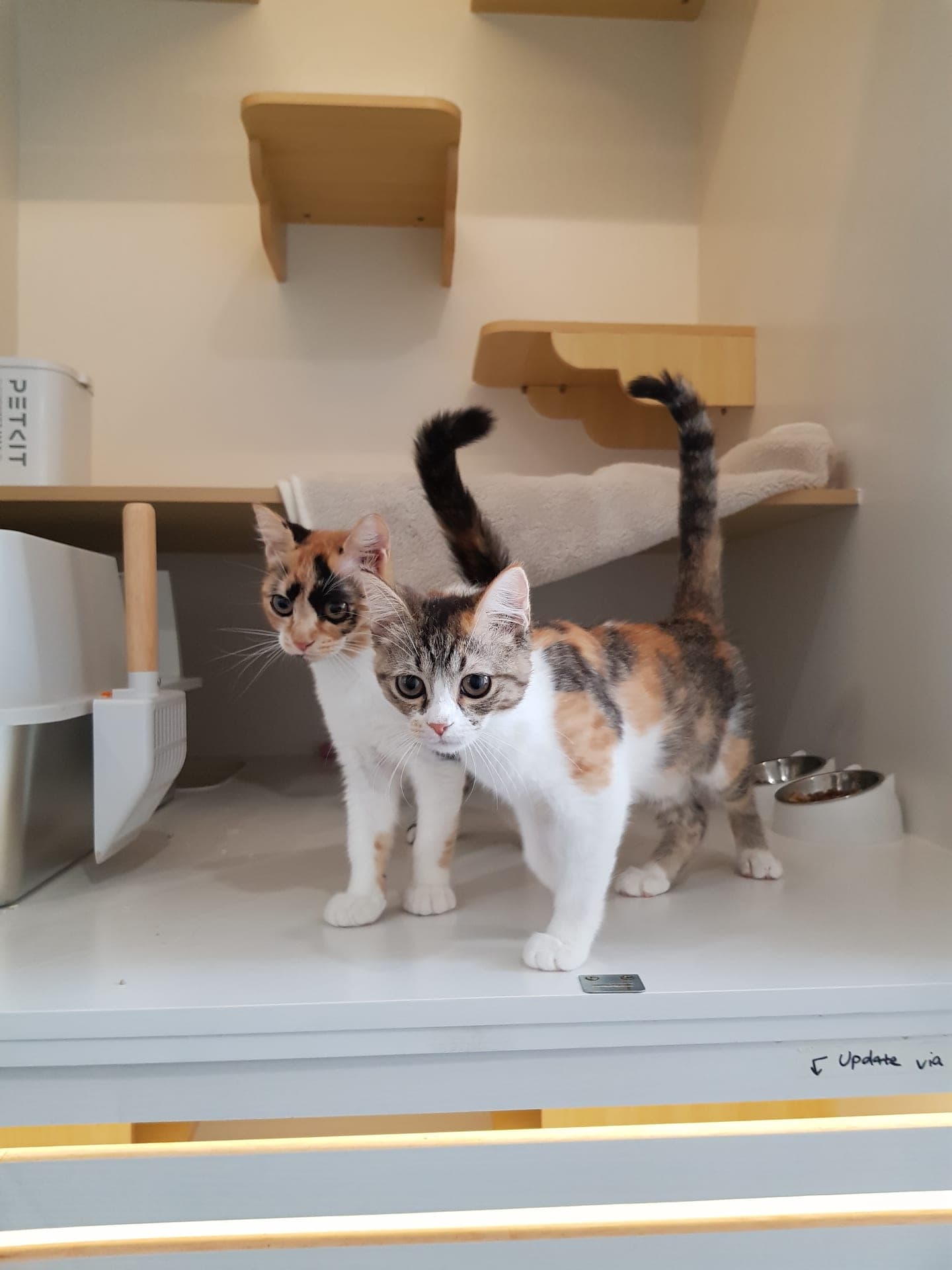
Two cats from one household in a suite of ours. Separate bowls, perches and a litter tray for a pair is the same principle as at home.
Open the door, but stay in the room
When the two cats can sit on either side of a gate without tension, let them share a room while you are there. Keep it short at first. Have treats ready, keep the wand toy going, and let each cat leave when it wants. The new cat should still have its own room to return to overnight and whenever you are out.
Over the following days and weeks, lengthen the shared time and give the newcomer more of the home. Many owners are surprised by how long the middle stage lasts. A pair who tolerate each other in week two may only start sleeping near each other well after that, and some cats settle into a polite coexistence rather than close friendship, which is a common result.
When the household has to travel
An introduction is at its most fragile in the first weeks, and that is often when a work trip or a family holiday lands. Cats who are still being introduced may be better in separate suites than crowded into one, so tell us how yours are getting on and we will say what fits. Cats who already live together and are comfortable sharing stay in one suite: here is how multi-cat stays work. We take kittens from 10 weeks old with at least one core vaccine, so a young second cat can have a short first stay away once they are old enough.
The published rate for a standard suite starts from S$60 a night. Availability is checked when you enquire, not on this page.
Frequently Asked Questions
1How long does it take for two cats to get along?▼
There is no fixed timetable. Many pairs need several days to a few weeks to tolerate each other, and some take longer, so pace the introduction by how the cats behave rather than by the calendar.
2Should the new cat have its own room at first?▼
Yes. A separate room with its own food, water, litter tray and hiding places lets the new cat settle and lets your resident cat notice the change through scent before they meet.
3What signs mean I should slow the introduction down?▼
Stalking, growling, a chase, a cat that stops eating or hides for long stretches, or one that stops using the litter tray. Go back to an earlier step and give the pair more distance.
4Can two cats share a suite at Kuro Cat Hotel?▼
Cats from one household share a suite at the suite rate. If two cats are still being introduced, tell us how they get on and we will say whether one suite or two suits them better.